
.png)
Q2 2026 was a quarter of strategic execution in a difficult macro environment. The Stacks ecosystem was focused on Bitcoin Staking, with key achievements including the publication of the Whitepaper, the testnet launch, and the solicitation of community feedback regarding the POX5 SIP. Other initiatives included the Stacks Foundry’s first Validate cohort, Ecosystem Grants Cycle 2, and the return of DeGrants.
Market Context
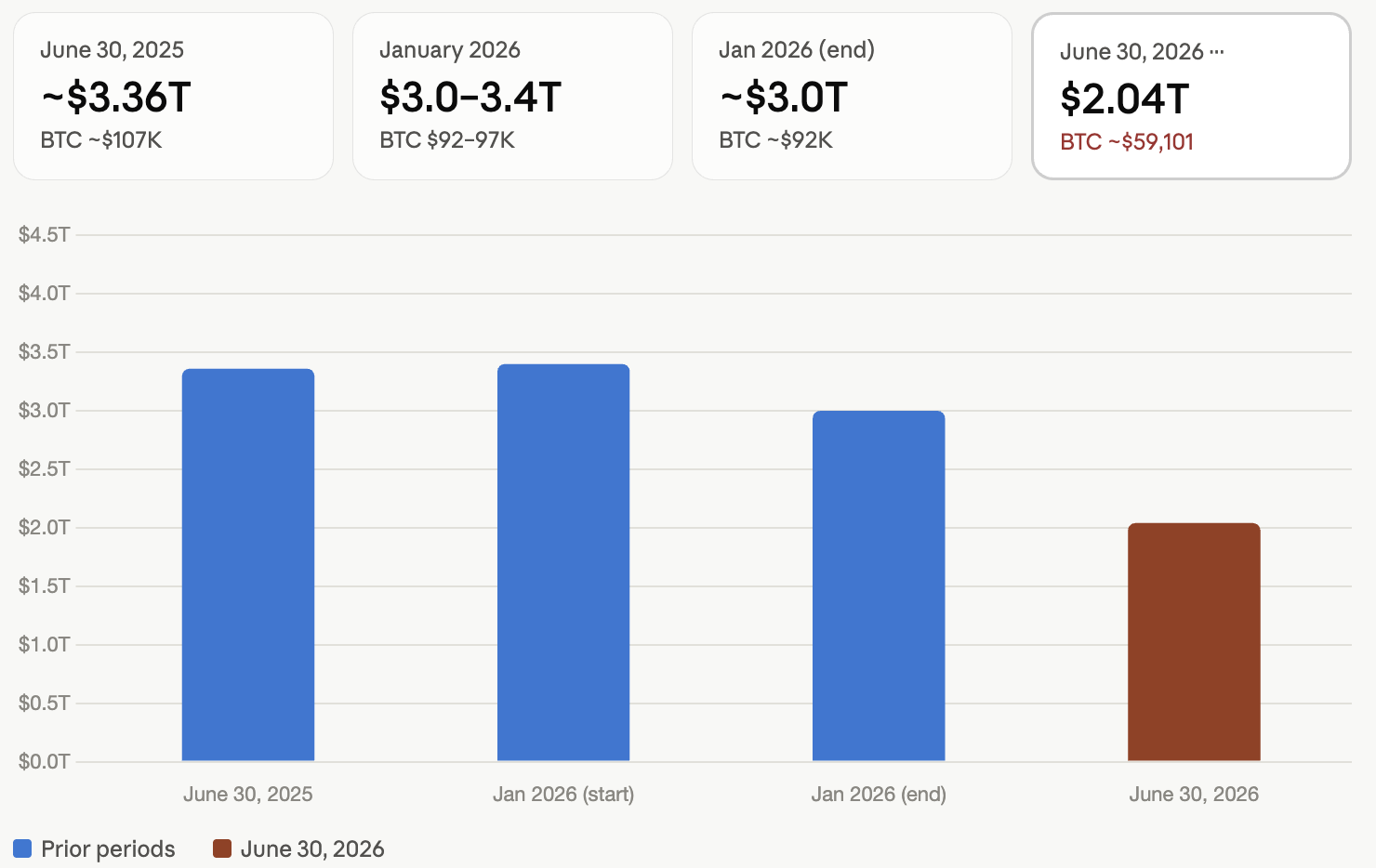
The global crypto market cap declined by approximately $1 trillion between January 1 and June 30, 2026, falling from $3.0 to $3.4 trillion at the start of the year to $2.22 trillion. The proximate causes are a rotation of global liquidity toward AI and equities, and persistent sentiment headwinds, attributable in part to growing concerns about quantum computing. Bitcoin traded at $88,000 in January 2026 and had declined to approximately $58,504 by June 30, 2026.
STX is correlated to Bitcoin at approximately 0.85 with a downside beta of approximately 1.3x and an upside beta of approximately 1.4x. The token opened Q2 at $0.224, reached a period high of $0.321 in May following a concentrated purchase event, and closed at approximately $0.169 on June 30 after the broader market sold off. The period low was $0.158. The current price represents approximately a 96% drawdown from the April 2024 all-time high of $3.84, which is consistent with where STX has traded at comparable points in prior cycles. The 2021 to 2022 cycle peaked at approximately $3.50 and bottomed at approximately $0.20, a drawdown of 94%.
The diminishing market conviction during the first half of the year is reflected in Bitcoin ETF flows. After peaking at roughly $170 billion in October 2025, assets under management for U.S. spot Bitcoin ETFs dropped to approximately $134 billion by January 6, 2026, when Bitcoin was trading near $93,800. While the launch of BlackRock's IBIT spurred $2.44 billion in net inflows during April (the strongest month for 2026 ETF flows), this served only as a temporary break in a steady trend of redemptions.
The Endowment interprets these trends as evidence that the prevailing drawdown stems from widespread institutional deleveraging rather than factors specific to Stacks. Consequently, any future recovery is expected to be catalyzed by the return of these institutional flows, rather than by shifts in retail sentiment.
Bitcoin market cycles have historically been cyclical in nature, with each drawdown eventually giving way to a recovery that clears the prior cycle's high; the Endowment's planning assumes Bitcoin has further to fall before this cycle bottoms, and that the subsequent recovery, consistent with the 2018 and 2022 cycles, will exceed the prior all-time high once institutional flows turn positive again.
Competitive Landscape
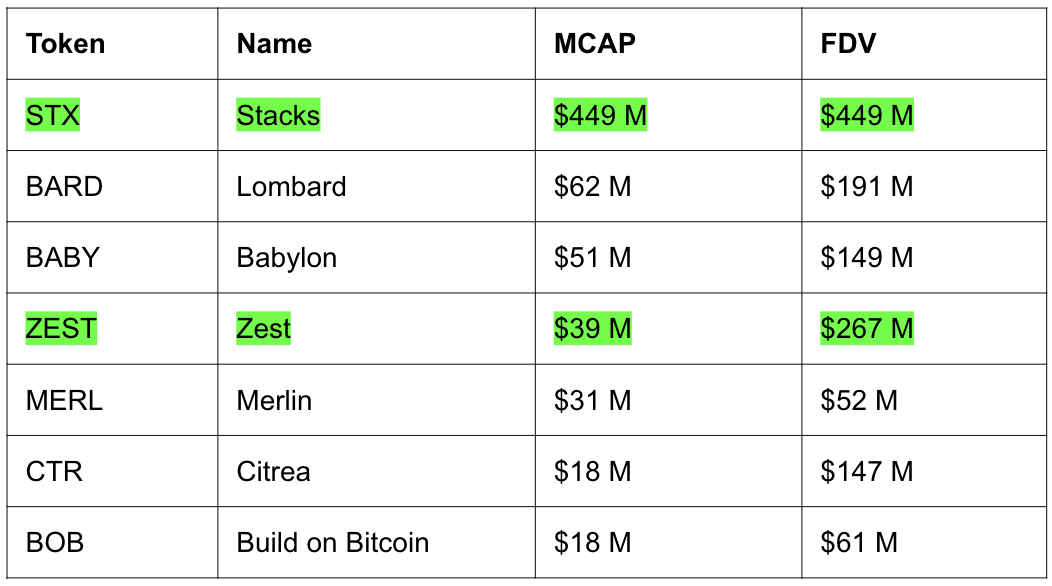
The competitive field has continued to narrow, and market capitalization data across comparable Bitcoin Layer 2 and Bitcoin-adjacent tokens illustrates the position Stacks now holds. STX leads the category in both market cap and FDV at $449 million, reflecting that the substantial majority of its supply is already unlocked and circulating. Peers trade at a meaningful discount and carry a much wider gap between market cap and FDV: Lombard (BARD) at $62 million against $191 million, Babylon (BABY) at $51 million against $149 million, Zest (ZEST) at $39 million against $267 million, and Merlin (MERL), Citrea (CTR), and Build on Bitcoin (BOB) each below $31 million market cap against FDVs several multiples higher. That gap reflects the discount locked in by supply in bear-market conditions, a dynamic that does not apply to STX, given its high free-float ratio.
Effectively, STX possesses one of the most significant free-float ratios among Bitcoin L2s. This structural reality implies that any future price appreciation will be almost exclusively a product of increased demand rather than restricted supply. The Bitcoin Staking initiative is specifically architected to serve as the primary catalyst for this demand.
One exception worth noting is Zest, whose token generation event the Endowment considers comparatively successful, given it was executed under a far more constrained budget than its peers. Several other Bitcoin projects are operating under significant financial pressure or have closed outright over the quarter. The Endowment's view is that Stacks is better positioned relative to its competitors now than at any prior point in the current cycle.
Treasury and Financial Position
As of the June 30 snapshot, STX represented roughly 96% of the treasury's total fair market value. This heavy concentration provides significant upside potential, particularly as Bitcoin Staking drives structural demand for the token. To preserve this STX exposure, the Endowment opted to liquidate BTC rather than STX to cover operating expenses during the second quarter.

The projected expenditure for H1 is roughly $10.7 million in fiat currency alongside $5.5 million in STX-equivalent. Because the market value of STX has fallen below our previous modeling from December and March, a larger volume of tokens is now necessary to fulfill the same fiat-denominated commitments; consequently, our spending is currently exceeding earlier estimates.
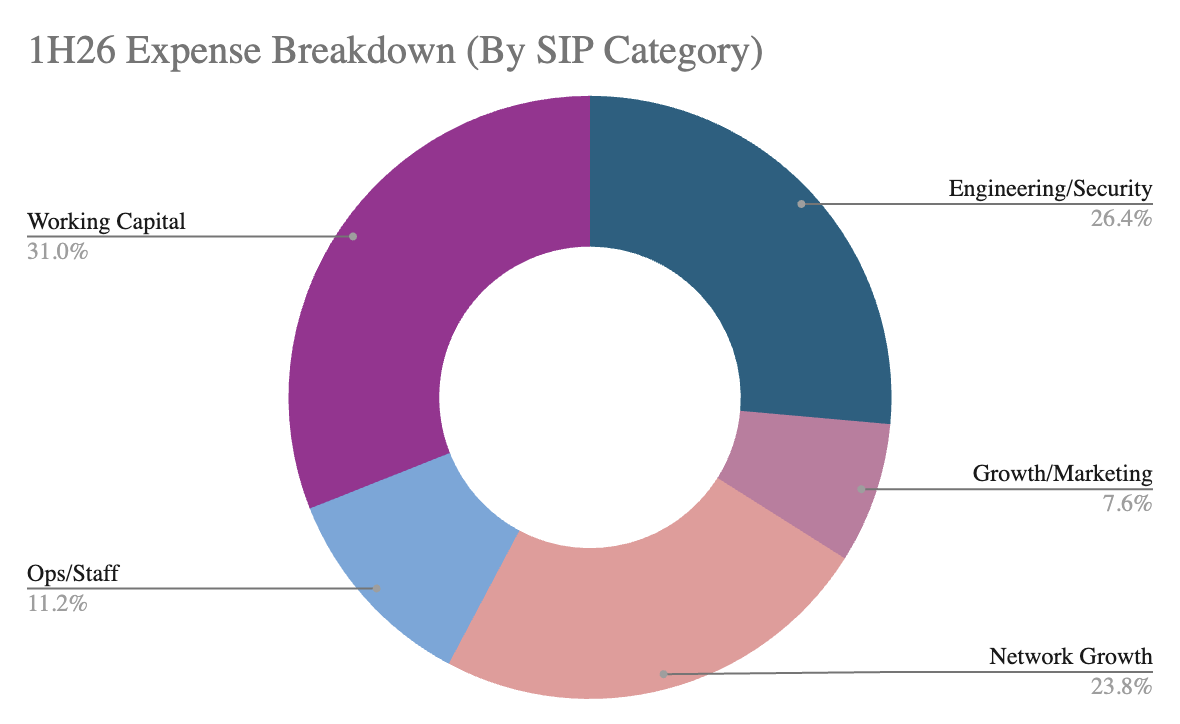
Our investment in Engineering and Security remains a top priority, exceeding budget targets by design to ensure a robust, battle-tested platform for our users. By proactively funding bug bounties and partnering with top-tier security firms like Trail of Bits and Clarity Alliance, we are reinforcing the integrity of the Stacks chain ahead of the upcoming Bitcoin Staking launch.
Although our Growth and Marketing expenditures currently trail initial projections, this represents a conscious tactical decision in response to bear market conditions. Rather than reducing commitment, we are strategically deferring these funds to ensure our primary promotional push coincides with the Bitcoin Staking release, maximizing impact. By pacing our outlays, we aim to align our most impactful initiatives with this critical milestone to capture maximum momentum.
Network Growth initiatives further reinforce the ecosystem by providing vital liquidity support to projects such as Bitflow, Hermetica, and Zest, complemented by strategic partnerships with industry leaders, including Fireblocks and BitGo. Our commitment to community-led innovation is underscored by $150,000 already distributed through ecosystem grants, with another $300,000 reserved for the next round of Grants & DeGrants.
Working Capital
In the wake of the Velar incident in February, the Endowment implemented a protocol threshold mandate for all subsequent DeFi deployments. Counterparties are now required to prove they possess adequate independent liquidity and volume before the Endowment will commit capital alongside them. This conservative stance intensified throughout the quarter as sentiment was further dampened by the Drift and KelpDao hacks. These events triggered a market-wide reduction in DeFi protocol liquidity, as investors became increasingly selective. While existing positions in DeFi dapps and our CEX MMs are established under the former framework and are being sustained, no further deployments are planned for H2, except for those essential to the Bitcoin Staking infrastructure.
For H2, the Endowment is designing an incentive-matching programme that rewards protocols for sourcing their own external liquidity rather than relying on Endowment capital as a structural backstop. The model under consideration would match or amplify the external liquidity a protocol brings in independently, rather than provide capital unconditionally. Notably, STX liquidity across centralized and decentralized venues stood exactly balanced for the first time in the Endowment's history as of the quarter's close, with CEX and DEX depth for the token now roughly equal rather than concentrated on one side. The Endowment views this balance as a meaningful structural improvement heading into the Bitcoin Staking launch, since it reduces the risk that a large move in either venue type would create outsized slippage or price impact for STX.
Bitcoin Staking
Bitcoin Staking is the Stacks ecosystem's most significant initiative, designed to drive structural demand for STX. The product enables BTC holders to earn approximately 3% native BTC yield by locking assets on the L1 alongside STX. Stacks holds a unique track record, having distributed 4,000+ BTC in yield via Proof-of-Transfer across market cycles. The market opportunity is substantial: while Ethereum and Solana staking hold $38–$50 billion, total BTC staking remains under $2 billion. Stacks enters this untapped market with an established yield record, the only SEC-qualified token sale in its category, and a technical design that avoids the incentive failures seen in competing models.
As STX demand surges, participants are no longer just encouraged but compelled to deploy capital into Stacks DeFi for more opportunities. This is a fundamental shift: participants must evolve into consistent, power users of the Stacks ecosystem who explore native applications and new use cases.
The Bitcoin Staking implementation is progressing on track across all components: the Stacks chain, sBTC, web applications, and wallet integrations. The PoX-5 testnet is live, and end-to-end tests are complete in code. The Endowment will manage the bootstrap period under PoX-5, deliberately setting the bond allocation capacity to create qualified demand rather than to maximize initial BTC volume. The liquid staking token product being developed by StackingDAO is integral to community participation: it allows participants with larger STX positions and limited direct BTC exposure to access Bitcoin Staking returns through a pooled mechanism rather than through direct L1 bonding.
SIP-045 activates PoX-5 and updates the Stacks stacking modules to support Bitcoin Staking. The SIP was revised during the quarter in a direct and prompt response to community feedback, explicitly excluding any increase to the coinbase reward. Any additional expenditure related to the Bitcoin Staking launch will be funded by the Endowment directly.
The go-to-market approach prioritises name-brand institutional partnerships as the mechanism for opening wider partner conversations. The primary post-launch success metric will be the month-over-month growth of BTC capacity committed to bonds. Fireblocks went live on Stacks mainnet in June, providing access to the custody infrastructure used by more than 2,400 institutional clients. Other custody integrations are the top business development priorities for Q3 and are necessary for the institutional capital in the pipeline to participate in Bitcoin Staking at scale.
Product and Technical Updates
The engineering organisation delivered the following during Q2 alongside the Bitcoin Staking programme work.
- New sBTC bridge: The redesigned bridge went live with a simplified three-panel deposit flow, estimated confirmation times with visible step-by-step status updates, and an estimated signer fees
- Fireblocks integration: The integration went live in June, representing the first major custodian relationship to activate for Bitcoin Staking.
- Mainnet node releases: Three clean releases on the 3.4.x line was shipped, from 3.4.0.0.1 on April 3 through 3.4.0.0.3
- Network reliability: The network maintained 97% active signer participation during Q2, with 90% of blocks arriving within 10 seconds of the previous one.
- Security hardening: Multiple denial-of-service and vulnerability classes were identified and patched during the quarter as part of continuous security investment.
- Smart contract caching: A caching layer was added for smart contract execution. DLMM calls that previously required several minutes to complete now execute in seconds, which is particularly significant for DeFi protocols dependent on frequent contract interactions.
- At-block removal: Support for pruned node configurations was added, reducing the infrastructure cost of running a Stacks node and lowering the barrier to validator participation.
- Clarinet developer tooling: Six releases were shipped across Q2, from v3.16 through v3.20, with the toolchain now carrying full PoX-5 capability.
- Grants Portal: A new application portal was built and launched for Ecosystem Grants Cycle 2, designed specifically to reduce the rate of misaligned applications produced by the Q1 open-format process.
- Leather and Stacks Labs partnership: The two organisations are collaborating more closely on wallet infrastructure, consolidating customer support across all entry points, and shipping critical Ledger hardware wallet upgrades
The primary Q3 objective is to ensure that Bitcoin Staking launches successfully and that the technical infrastructure performs reliably from day one under institutional-scale participation. The supporting deliverables are the Pyth oracle migration, the PoX-5 network cutover, and continued incremental improvements to the Developer Tools, Explorer, and API surfaces.
Ecosystem Funding: Grants & DeGrants
From June 5 to June 26, the Q2 application window operated on a more condensed timeline than the six-week Q1 period, which had yielded over 300 submissions, many of which were misaligned with core objectives. To enhance the quality and relevance of proposals, three primary structural updates were implemented: the launch of a dedicated Grants Portal to streamline the application process, the issuance of a dedicated Request for Projects, and a transition from an open-category format to four targeted strategic pillars. These criteria include Privacy, Agentic Applications, Real-World Assets, DeFi, and Perpetuals. Final outcomes are scheduled for release in early July. Furthermore, any priority-track applicants not chosen during this cycle will have their submissions automatically advanced to Q3.
Additionally, DeGrants returned in Q2. DeGrants is community-managed. DeGrants is organized by members of the Stacks community called Community Stewards, along with the Stacks Endowment. Stewards work together to decide how funding is allocated. Applications will be reviewed by a committee of 3 Community Stewards using a simple scoring process designed specifically for community grants.
Looking ahead in Q3
Looking toward Q3, the Endowment faces the most pivotal period in its history. We’re all aligned toward one central objective: the successful launch of Bitcoin Staking. While the market environment remains challenging, the Endowment's strategy does not rely on a macro recovery prior to launch. Instead, the working thesis is that Bitcoin Staking will provide the ecosystem with a foundational, structural source of demand independent of broader market trends.
